Unwinding Strings
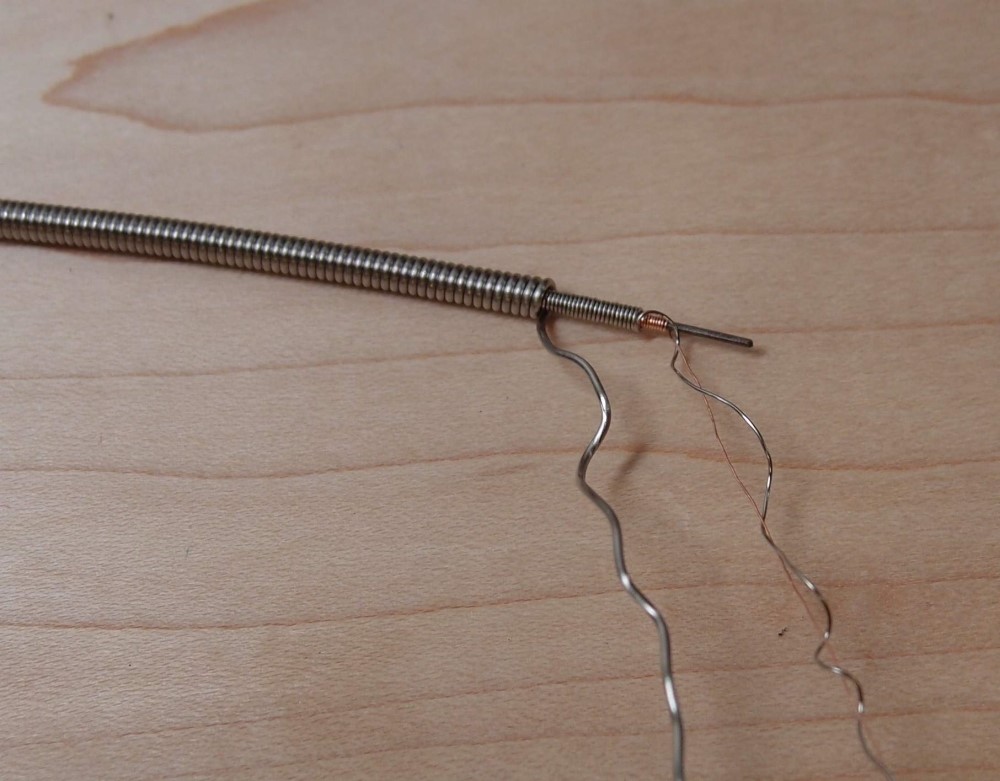
I like to build short-scale basses, Unfortunately, the manufacturers don't like to make short-scale strings, and stores don't like to stock them. And some lengths, like 25" 'pico', simply don't exist. However, you can make your own from readily available long-scale sets.
Unwinding a string to any length is easy. Put it on the guitar and figure out what length you need, or where you need to unwind to. Saturate the inch below that point with Crazy Glue to fix it in place, just a couple of drops will do. Cut off the excess string, then unwind the outer windings, but not the inner windings, enough to give you a tail to wrap on the tuner post.
Try not to twist the entire string, that could ruin it, grip it tightly at the Crazy Glue as you unwind. It will take a while, and you will end up with a surprising pile of spiral spaghetti wire when you are done. Finally, smooth in the cut winding and Crazy Glue it down so you don't leave a sharp point sticking out. I have found that unwinding is necessary on strings larger than 085". That size and smaller will wrap on a bass tuner post without modification.
Most long-scale string sets will work fine down to 30". Shorter than that, and things get sloppy, heavier strings are necessary. You can experiment yourself by capo-ing a standard scale bass at various frets and then re-tuning it to EADG. On a 34" bass, the first fret makes 32", second makes 30", etc, 5th makes 25". See for yourself if you like how it plays.
To make a 25" pico-scale string set, start with a light 5-string set. Remember, an EADG pico is the same as a BEADG 5-string, capo'ed at the 5th fret, minus the G string. An off-the-shelf D'Addario light 5-string set is something like 125 100 080 060 045. I don't recommend a heavier set, as when you shorten a heavy B/E string it gets a very stiff feel, a 125 feels much better. Anything in the ballpark will work; if I was to spec a custom set, I would try 120 100 080 060, or 115 095 075 055, but going with a standard set will save you money, and it doesn't make that much difference.
Once you can do this, you can make any length of string you want out of anything that is available. 25" half-rounds? 30" flats? 27"? No problem. In my case, I have a box full of long-scale strings just waiting to be re-purposed as shorts. Individual 125 strings are also commonly available at reasonable prices. So start exploring the world of custom-scale basses - it's fun !!!
Questions or Inquiries?
Just want to say Hello? Sign the .