Hand Saws
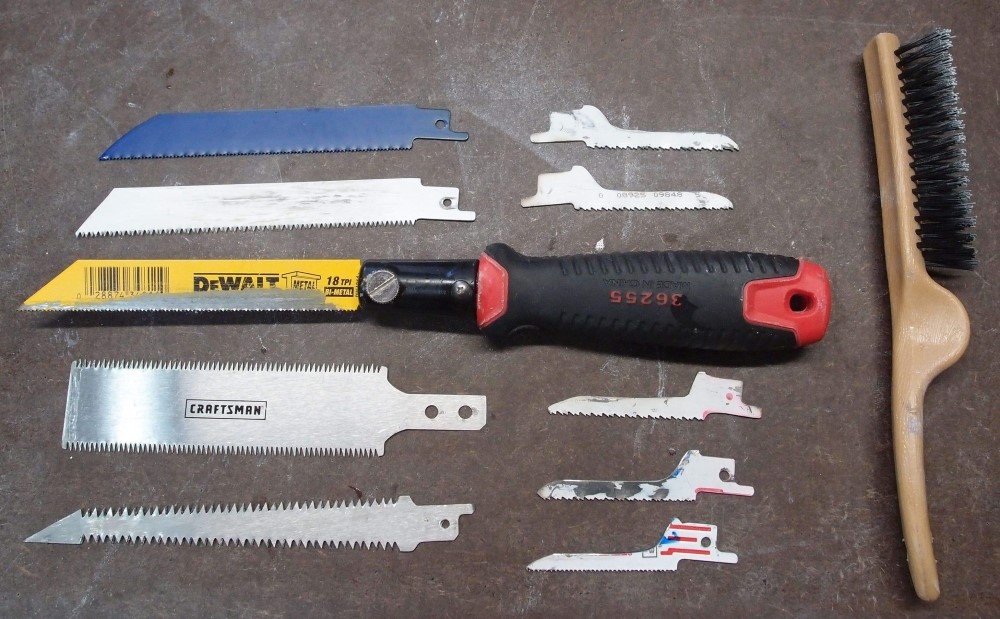
Here is a terrific little saw handle that takes Sawzall blades. It comes with an array of blades, including the dangerously sharp flush-cut and rather dodgy drywall blades, and a few others that I've long since used up, but it will fit any Sawzall blade. But what really makes this thing great is when I started making my own blades - all the small ones along the right. I cut these from much larger Sawzall blades that I bought, using an angle grinder, and shaping them on the bench grinder. Sawzall blades all cut on the pull stroke, but as you can see, two of these blades cut on the push stroke, because I cut them reversed from the parent blade. The tangs are easy to make. Push blades are good for cutting through finished or laminated surfaces. These little blades give me a hand-held jigsaw, very useful for many loothery tasks. This saw is a Craftsman, so you better hustle on down to your local Sears and get one before it closes. Mine is on the death list. StewMac should pick up this idea.
The hairbrush is something else. Have you ever been sanding something, and the sandpaper gets all gummed up? You know it's still sharp, but what can you do? An old hairbrush is perfect for cleaning sandpapers, and even belts. How much do you think StewMac would charge for a hairbrush, er, "luthiery abrasive restorer"?
I pick on StewMac, but only because I love 'em.
Update: You can get this tool at Lowes, branded Cobalt, and Home Depot - DeWalt.
.

Questions or Inquiries?
Just want to say Hello? Sign the .