Fret Slot Cleaning Tool
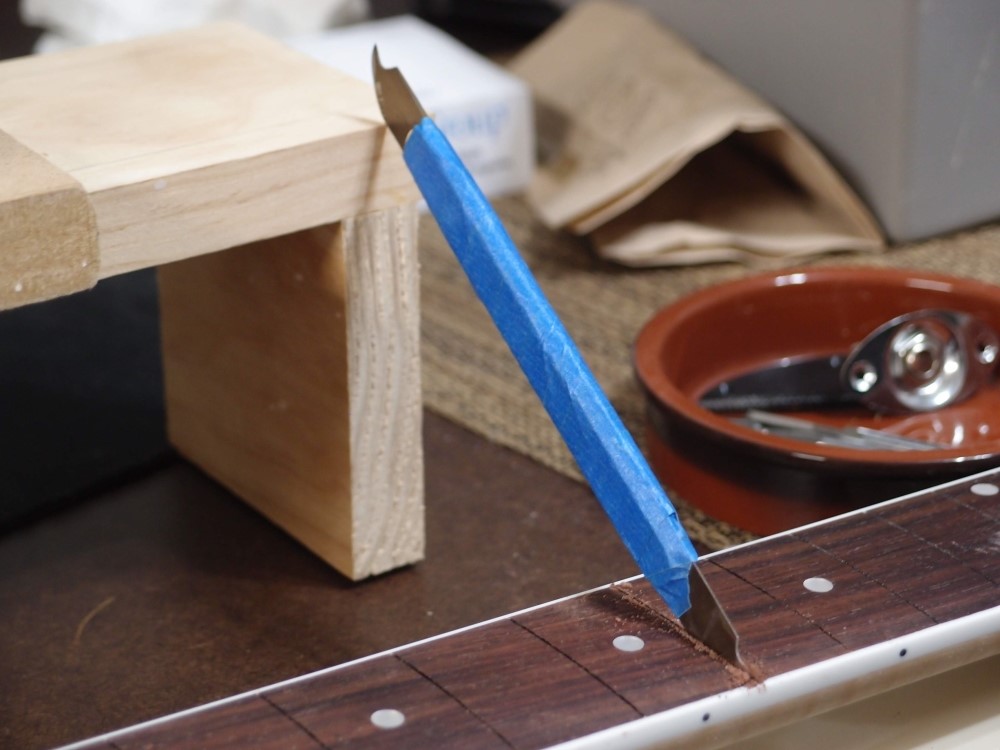
This is a fret slot cleaning tool that I made from my old favorite steel packing strap in about 5 minutes. Once again, the inspiration is the StewMac catalog, where their tool is much nicer, and about $15. I ground the strap to a hooked point on the bench grinder and made the handle from popsicle sticks and tape. My tool is double-ended, very similar to my binding scrapers. The material is nearly the right thickness, a few passes on a file and it was perfect. The edges are all square, so the tip is a tiny chisel.
For an unbound neck, you can easily clean out the fret slots with your fretting saw. But that won't work on a bound neck. You can see how much gunk I dug out of that slot, and I thought I had already cleaned them all pretty well with an Exacto knife. The hook lets you get right up to the inside edge of the binding and dig out the cement that squeezed into the slot. The curved back of the hook can be used as a fulcrum.
It is important to get the fret slots cleaned out good, because if the frets are too tight a fit in the slots, it can induce a back bow on the neck, which can be a disaster if you have a single-acting truss rod.
Curt:
June 13, 2023 at 4:38 PM
Nice idea on the fret slot cleaning tool!
I have to find something or make one. I have some glue that snuck into some fret slots and need to get it out. Stew Mac may have the tool but they are so crazy expensive on everything!